
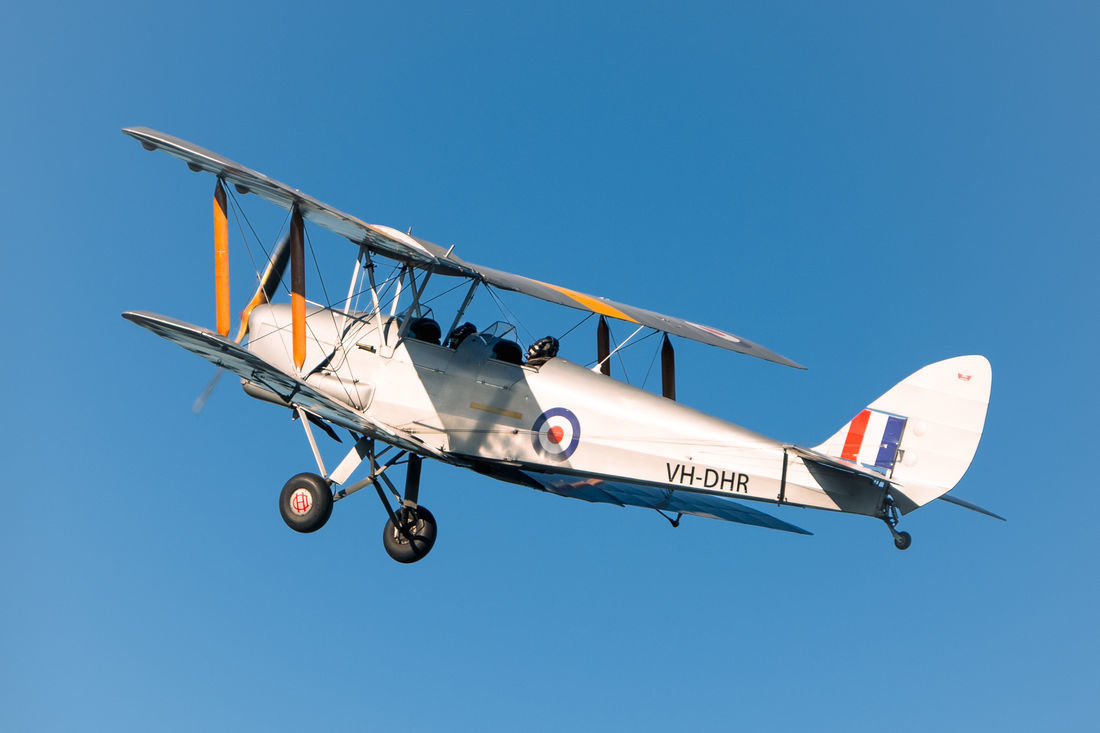
The Tiger Moth Experience
People often ask me what it’s like to fly in a Tiger Moth.
The obvious answer is that it’s very different from flying in a modern aeroplane. But that doesn’t really tell you much.
The difference begins before the engine has even started. You don’t sit beside the pilot. You don’t open a conventional cabin door and slide into a seat. There’s no roof, no cabin lining and very little separating you from the aeroplane itself.
And once you’re in the air, there’s the constant sound of the engine, a subtle vibration through the aircraft, fabric-covered wings and flying wires in your field of view, and open sky above your head.
So, what’s it actually like?
Let me take you through a flight.
Welcome to the Front Cockpit
One of the first things you'll notice about the Tiger Moth is the seating arrangement.
Rather than sitting on the left or right as you would in most light aircraft, you sit on the centreline. The passenger occupies the front cockpit and I fly from the cockpit behind.
It's a fairly narrow cockpit, which isn't surprising when you remember that the Tiger Moth was designed as a military trainer.
During the war, the person occupying your seat would have been sitting on a parachute.
These days, we give you a cushion.
There's no interior trim or insulation. Inside the cockpit you can see the steel fuselage frame and, beyond that, there's essentially the fabric covering of the aeroplane.
The view is equally distinctive.
Look forward and you'll see the windscreen, cabane struts and bracing wires. Look left or right and you'll see the lower wings, flying wires and struts, with the Yarra Valley beyond them.
Look straight down and you'll mostly see the walkways on the lower wings, so for sightseeing you're much better looking out to either side.
And if you look up?
You'll see the back of the fuel tank.
And sky.
Lots of sky.
Getting Into a Tiger Moth
Even getting aboard is part of the experience.
Before you climb onto the aeroplane, I'll show you where to put your hands and, more importantly, your feet.
You can't simply stand anywhere on a Tiger Moth's wing. The wing is fabric-covered, so your feet need to remain on the reinforced walkway. Put your foot in the wrong place and you could quite literally put a hole through the wing covering.
Once you're standing on the walkway, I'll walk around to the front of the wing and climb up.
You'll grab hold of the cabane struts, step up until you're standing with both feet on the seat, then lower yourself into the cockpit.
There are small doors on the sides of the cockpit, but it's certainly not the same as getting into a modern light aircraft.
Once you're settled, I'll point out the lower part of the four-point harness. You'll buckle and adjust that first, followed by the two shoulder straps.
Now you're part of the aeroplane.
Flying Helmet and Goggles
Next comes the flying helmet.
The communications headset is built into the helmet, so once you've got it on and fastened I'll position the microphone for you. Then you put on your flying goggles.
If you wear hearing aids, the sequence is slightly different. They need to be removed before putting on the helmet, so I'll usually leave the helmet off until we've completed the safety briefing. That way you can hear me properly while I'm talking you through everything.
By this point you're sitting in an open cockpit, wearing a flying helmet and goggles and surrounded by the exposed structure of a 1930s biplane.
It's starting to feel a little different from your average scenic flight.
“They’re Mine and I Need Them to Fly the Aircraft”
The Tiger Moth was designed as a trainer, so the front cockpit isn't simply a passenger compartment.
It has flight controls.
I'll point out the rudder pedals, trim lever, throttle and fuel shutoff valve.
And then I'll give you one very simple instruction:
Don't touch them.
I usually put it this way:
“They’re mine and I need them to fly the aircraft.”
Where you put your feet is important too. Most people naturally want to stretch their legs forward, which would put their feet near the rudder pedals.
Instead, I'll ask you to bring your feet back towards the base of the seat while remaining comfortable.
Alongside your leg is a piece of sheet metal covering the connecting rods between the front and rear trim levers. You're welcome to rest your leg against it, although you might occasionally feel something moving against your leg.
Don't worry.
That's just me adjusting the trim from the cockpit behind you.
A Quick Tour of the Instruments
Next I'll show you the instrument panel.
We start with the altimeter.
Lilydale Airport is about 250 feet above sea level, so I'll set the altimeter accordingly and tell you roughly how high we're going to fly.
Then there's the airspeed indicator.
The Tiger Moth normally cruises at around 80 knots, so I tell passengers they'll generally see the needle sitting more or less on the 8.
Next is the RPM gauge.
Normal cruise power is around 1,950 RPM, while full power is approximately 2,100 RPM. If we're doing aerobatics, you might see as much as 2,300 RPM.
I'll briefly point out the vertical speed indicator, turn and slip indicator and compass.
“This one tells us if we're climbing or descending, this one tells us if we're turning, and this one tells us our direction.”
Then I usually admit that I don't really use any of them very much.
I know the valley pretty well.
And I can see outside the aeroplane.
The Safety Briefing
Next are the cockpit doors.
There's not much to remember here: your doors remain closed throughout the flight.
Then we get to the emergency briefing.
“In the event of an emergency, you'll hear me through your headset telling you to open your doors.”
I'll demonstrate how to do that.
“When we come to a complete stop on the ground, you'll need to release your harness.”
I'll show you how to release it.
Then there's one last, rather important instruction:
“The last thing you'll need to do before you run away from the aircraft is remove your flying helmet, because it's attached to the aircraft with about three feet of cable and you're not going to get very far if you don't.”
It usually gets a laugh.
That's partly why I say it that way. The emergency briefing is serious, but I also want you to remember it.
There's also no smoking on board.
Although if you somehow manage to light one up in an open-cockpit Tiger Moth at 80 knots, I'll be very impressed.
For most of the flight you're free to look in any direction you like. There is one exception.
During take-off and landing, I need you to keep your entire body inside the cockpit.
There's a good reason for that, which you'll discover when we come back to land.
And that's the briefing done.
Sit back, relax and enjoy the flight.
Bringing the Tiger Moth to Life
Starting a Tiger Moth isn't quite a matter of turning a key.
If I've got somebody available to swing the propeller, I'll climb into the rear cockpit, fasten my harness and put on my helmet and gloves.
Then we go through the starting procedure.
I'll call:
“Brakes ON.”
“Fuel ON.”
“Throttle SET.”
“Front switch ON.”
The person standing at the propeller responds:
“Both switches ON.”
“Contact.”
Then they swing the propeller.
The engine comes to life.
I'll switch on the rear magneto and settle the engine at around 800 RPM, then signal for the chocks to be removed.
Once they're clear, I'll switch on the intercom and establish communications with you.
If I'm operating on my own, the procedure looks a little different because I'm the person who has to swing the propeller. I'll configure the magneto switches appropriately, start the engine from the front of the aircraft, switch on the remaining magneto, remove the chocks and then climb into the rear cockpit.
It's not quite as convenient as pushing a starter button.
But very little about flying a Tiger Moth is about convenience.
Taxiing
With the engine running and communications established, you'll hear me make our first radio call:
“Lilydale traffic, Tiger Moth Delta Hotel Romeo, taxiing runway three six, for a local flight, Lilydale.”
Depending on the wind, it might be runway 18 instead.
Before we start moving, I'll check carefully for other traffic.
Then we begin taxiing towards the run-up area.
You'll notice fairly quickly that we don't travel there in a straight line.
From the rear cockpit I have very limited visibility directly ahead, so I'll slowly weave the Tiger Moth from side to side as we taxi. Each turn gives me a view around the nose so I can see where we're going.
Throughout the taxi I'm also listening to the radio, building a mental picture of the other aircraft operating around Lilydale.
Ready for Take-Off
The Tiger Moth's pre-takeoff checks are fairly simple.
I'll stand on the brakes and increase the engine to around 1,600 RPM, then check each magneto in turn. You'll hear the engine note change slightly as I do it.
I'll bring the throttle back to make sure the engine idles at around 600 RPM, then return it to approximately 800.
Next I'll check the flight controls for full, free and correct movement.
If you're watching the stick and pedals in your cockpit, you'll see them moving as I operate the controls from behind you.
I'll close my cockpit doors, set the trim and check the altimeter.
Meanwhile, I'm still listening for traffic.
If somebody reports turning base, I'll make sure I can see them before deciding whether there's enough time for us to depart. If they're already on final, we'll wait for them to land or complete their touch-and-go.
Once I'm satisfied it's clear, you'll hear:
“Lilydale traffic, Tiger Moth Delta Hotel Romeo, entering and shortly rolling three six, departing east, Lilydale.”
Then we enter the runway.
Take-Off
The acceleration in a Tiger Moth is surprisingly gentle.
I'll gradually increase the throttle until we're at full power, keeping the aircraft tracking straight along the runway.
At around 20–30 knots, a little forward pressure on the joystick brings the tail up.
You'll see the attitude of the aircraft change as the nose lowers and we continue accelerating.
At around 50 knots, I'll ease the Tiger Moth off the ground.
And you may not actually feel the moment we become airborne.
Lilydale's runways are fairly smooth, so there's generally no dramatic disappearance of bumps or vibration.
You'll probably see that we're flying before you feel it.
If we're departing from runway 18, I'll settle into a climb at around 60 knots almost immediately.
Runway 36 is a little more fun.
I'll often keep the Tiger Moth just 20 or 30 feet above the runway and allow it to accelerate to around 80 knots.
That takes us past the hangar.
If you've brought family or friends along to watch, that's your chance to give them a wave as we fly past.
As we approach the airport boundary fence, I'll raise the nose and settle back to around 60 knots for the climb.
Now we're really going flying.
What Does It Feel Like?
Once we're settled into the flight, there's one thing that never really disappears.
The noise.
A Tiger Moth is constantly noisy.
There's also a constant vibration. It's subtle rather than uncomfortable, but it's there.
Sometimes you can actually see it.
Look at the underside of the wing and you might notice a little movement in the fabric, or you may see one of the flying wires vibrating in the airflow.
The aeroplane is always reminding you that it's alive around you.
Surprisingly, I don't think most passengers particularly notice the height.
On a typical scenic flight we'll generally be somewhere around 1,500 to 2,000 feet, depending on where we're going.
If we're doing a low-level run along the river, it's quite different. Suddenly you can see much more detail in the landscape and everything looks considerably bigger.
On an aerobatic flight we'll be higher, and you might even find yourself looking down at other aircraft taking off or landing beneath us.
What About the Wind?
This surprises people.
You're actually quite well protected from the wind inside the cockpit.
There may be a little more airflow coming in from the right-hand side due to the propeller and slipstream, but you're certainly not spending the whole flight being blasted in the face by an 80-knot wind.
Put your hand or arm outside the cockpit, though, and it's a completely different story.
At cruising speed, the air outside is rushing past at around 160 km/h.
You'll suddenly appreciate just how much protection the cockpit was providing.
That's also why we tell you to keep a good grip on your phone if you're taking photographs.
You're welcome to take photos during the flight, but if you put your phone out into that airflow, be ready for it.
The wind is quite capable of pulling something from your grasp.
And if you drop your phone from a Tiger Moth, turning around to pick it up isn't really an option.
Is It Cold?
As a general rule, the temperature drops by around 2°C for every 1,000 feet you climb.
So if it's 20°C on the ground, you might expect roughly 18°C at 1,000 feet above the ground and around 16°C at 2,000 feet.
During the warmer months, that's generally not a problem.
Winter is a whole different ball game.
My advice for winter passengers is simple:
You should be uncomfortably warm while you're standing on the ground.
If you're thinking you've probably put on one layer too many, you've probably got it about right.
Remember, there's no heater and no insulation inside the Tiger Moth.
Any exposed skin tends to feel the cold. I usually notice it particularly on my face and nose.
And even when I'm wearing thick socks, sometimes my feet feel like a couple of ice blocks.
There's another oddity I've noticed flying around the Yarra Valley. At around 3,000 feet, there can sometimes be a very noticeable drop in temperature.
I don't know why.
It's almost as though you've crossed an invisible barrier into colder air.
My Favourite Days to Fly
People might assume my favourite Tiger Moth weather is a completely clear blue sky.
It isn't.
Give me a partly cloudy day with the cloud base somewhere between about 1,500 and 2,500 feet.
On days like that we can climb up and fly between the clouds, dodging and weaving our way through the gaps.
From an open cockpit, they can seem incredibly close.
You feel as though you could reach out and touch them.
And occasionally, when the sun and cloud are in just the right positions, something rather special happens.
You'll see the shadow of the Tiger Moth projected onto the cloud, surrounded by a rainbow-coloured halo.
The phenomenon is called a glory.
You see the unmistakable silhouette of the biplane—wings and all—apparently floating on the cloud with rings of colour around it.
It doesn't happen every time.
But when it does, it's one of those sights that makes a partly cloudy day far more interesting to me than an empty blue sky.
A Scenic Flight Is Gentle
Once we're established on course during a normal scenic flight, there isn't a great deal of manoeuvring.
We pretty much settle onto our route and stay there until it's time to turn around.
That gives you the opportunity to relax, look around, take photographs and enjoy the Yarra Valley without the aeroplane constantly changing direction underneath you.
When it's time to head back towards Lilydale, I'll normally use a standard turn of around 30 degrees of bank.
A normal scenic flight in a Tiger Moth is, despite the appearance of the aircraft, actually quite a gentle experience.
An aerobatic flight is a little different.
Going Around the Loop
The standard aerobatic manoeuvres I currently fly with passengers are loops and barrel rolls.
For a loop, the first indication that something is about to happen will probably be the engine.
You'll hear me increase the power to full.
Then you'll see the nose lower as we accelerate towards approximately 110 knots.
Before we begin, the best place to look is towards the left wingtip.
As I pull the Tiger Moth from the dive into the climb, you'll feel the G-force start to build. Initially you'll experience around 2 G, so you'll feel roughly twice your normal weight pressing you into the seat.
Keep watching that left wingtip.
You'll see it climb and eventually go beyond the vertical.
When it does, look straight up.
You'll see the ground above you.
As we pass over the top of the loop, the sensation changes. Depending on how hard I'm pulling the joystick, you may briefly feel quite light or almost weightless.
Then we start coming down the other side.
As I recover from the loop, the G builds again and can reach around 3.5 G.
A few seconds later we're straight and level again.
And the Yarra Valley is back where it belongs.
The Barrel Roll
For a barrel roll, we'll accelerate to around 100 knots.
Again, you may feel the onset of G as I transition from the dive into the climb.
Once the wings reach around a 45-degree angle to the horizon, I'll apply aileron and rudder while continuing to apply back pressure on the joystick.
From there, the Tiger Moth describes a corkscrew path through the air.
The horizon rolls around you as the aircraft climbs, passes through inverted and continues around until we're straight and level again.
All the aerobatic manoeuvres I perform are positive G.
You may feel a little weightless over the top, but I'm not deliberately applying negative G.
There's a very practical reason for that.
The Tiger Moth has a gravity-fed fuel system.
Negative G and gravity-fed fuel systems aren't particularly good friends.
I'd rather the engine kept running.
Heading Home
Eventually it's time to head back to Lilydale.
There are two ways I might bring us home depending on the flight we're doing: a normal circuit join or a straight-in approach.
At around six miles from the airport, you'll hear me make an inbound call:
“Lilydale traffic, Tiger Moth Delta Hotel Romeo, six miles east, inbound two thousand, Lilydale.”
We may be at 1,500 feet rather than 2,000 depending on the flight.
From there I'll position the Tiger Moth to join the circuit, normally on either the crosswind or downwind leg depending on the runway in use and the direction we're approaching from.
Once we're in the circuit—or at around three miles if we're making a straight-in approach—I'll do something you were specifically told not to do.
I'll open my cockpit doors.
It gives me a little more freedom to move around and allows me to lean farther out of the cockpit during the approach.
Your doors, however, stay closed.
Coming In to Land
As we're about to turn onto the base leg, you'll hear another radio call:
“Lilydale traffic, Tiger Moth Delta Hotel Romeo, turning base three six, full stop, Lilydale.”
I'll reduce power to around 1,300 RPM, begin the turn and slow the Tiger Moth to around 60 knots.
The circuit is normally flown at about 1,000 feet above the ground. On base we'll descend towards 500 feet.
As we approach 500 feet, I'll begin the turn onto final.
And now you'll discover why I asked you to keep your entire body inside the cockpit during landing.
I can't see directly ahead.
From this point onwards, I'm constantly looking out of the left-hand side of the Tiger Moth to see the runway.
That's why I've opened my cockpit doors—it allows me to lean out a little farther and gives me the freedom of movement I need.
So if you lean out of the left side at this particular moment, the main thing I'm going to see instead of the runway is you.
I'd prefer the runway.
Final Approach
On final, I'm constantly judging three things: our height, our airspeed and how far we have left to run to my aiming point.
I'm trying to maintain the ideal approach profile at around 60 knots.
Sometimes we'll encounter a little sink before reaching the runway.
If that happens, you may hear me add perhaps 100 RPM and notice a slight change in the attitude of the aircraft as I maintain our speed and approach profile.
They're small corrections.
As we cross the airport boundary fence, I'll begin slowing the Tiger Moth towards about 55 knots and prepare for the flare and touchdown.
From here, landing becomes a juggling act between the throttle and joystick.
I'm trying to time things so that the wheels touch the runway just after the throttle reaches idle.
If I do it well, you'll hardly notice we're not flying any more.
Back on the Ground
Once the main wheels touch, I'll apply a little forward pressure on the joystick to kill the remaining lift and keep us firmly on the ground.
As we slow, that forward pressure gradually increases until the joystick is all the way forward.
Eventually the tail begins to settle.
At that point, the stick comes all the way back.
Then I simply let the Tiger Moth slow down at its own pace.
I generally don't use the brakes during the landing roll. They're mainly used during start-up and the run-up, with occasional differential braking to help with turns on the ground.
We'll taxi off the end of the runway and follow the taxiway back towards the hangar.
And we'll be weaving again.
Just as on the way out, I'm looking from side to side around the nose to see where we're going.
Back at the Hangar
Once we're parked, I'll switch off the magnetos in the rear cockpit.
The engine stops.
After spending the flight surrounded by the constant sound and subtle vibration of the Tiger Moth, everything suddenly becomes rather quiet.
I'll switch off the intercom, remove my gloves and flying helmet, release my harness and climb out.
If I'm operating on my own, I'll ask you to stay in the cockpit while I chock the wheels. If I've got ground crew with me, they'll take care of that.
Then I'll take your flying helmet and put it into the rear cockpit before helping you with the shoulder straps.
Getting out requires the reverse of what we did at the beginning.
I'll talk you through it:
“Grab hold of both cabane struts. Watch out for the fuel tank as you're standing up. Stand on the seat with both feet, then climb out onto the wing.”
From there, you step onto the reinforced walkway and make your way back down to the ground.
And that's it.
You've flown in a Tiger Moth.
So, What’s It Really Like?
It's noisy.
It vibrates.
It can be cold.
You sit surrounded by wings, struts and wires in a narrow cockpit with open sky above your head.
You might wave to your family as you fly past the hangar at 80 knots. You might see the fabric beneath a wing gently vibrating in the airflow. You might put your hand outside the cockpit and suddenly discover what 160 km/h of wind really feels like.
On the right day, you might find yourself weaving between clouds that seem close enough to touch.
If you're particularly lucky, you might even see the shadow of the Tiger Moth floating on a cloud beside you, surrounded by a rainbow halo.
And if you're feeling adventurous, you can look straight up during a loop and see the Yarra Valley above your head.
But perhaps the thing that surprises people most is just how gentle a normal Tiger Moth flight can be.
Take-off isn't a violent rush into the sky. You may see that we're airborne before you feel it.
A scenic flight doesn't involve throwing the aeroplane around. Most of the time we're simply cruising over the Yarra Valley at around 80 knots while you take in the view.
And if I get the landing right, you might barely notice the moment the wheels touch the ground again.
Flying in a Tiger Moth isn't really about getting somewhere.
It's about experiencing the aeroplane itself.
And there aren't many aeroplanes that let you experience flying quite like this one.
View our flights!
Purchase a gift voucher!
Enquire Now!